Runoff Water Management in Cannabis Cultivation
Runoff water is a key indicator of root-zone health in controlled cannabis farming. By measuring what drains out after irrigation, growers see exactly how nutrients and salts behave in the substrate. This practice helps fine-tune feed strength, prevent buildup, and protect crop quality.
Every irrigation delivers water, nutrients, and oxygen to the root zone. Not all of it stays. A portion drains out as runoff, carrying dissolved salts and showing whether the feed is balanced. If runoff volume is too low, salts accumulate and stress plants. If too high, nutrients wash away and efficiency drops. Logging runoff protects consistency and supports GACP compliance.
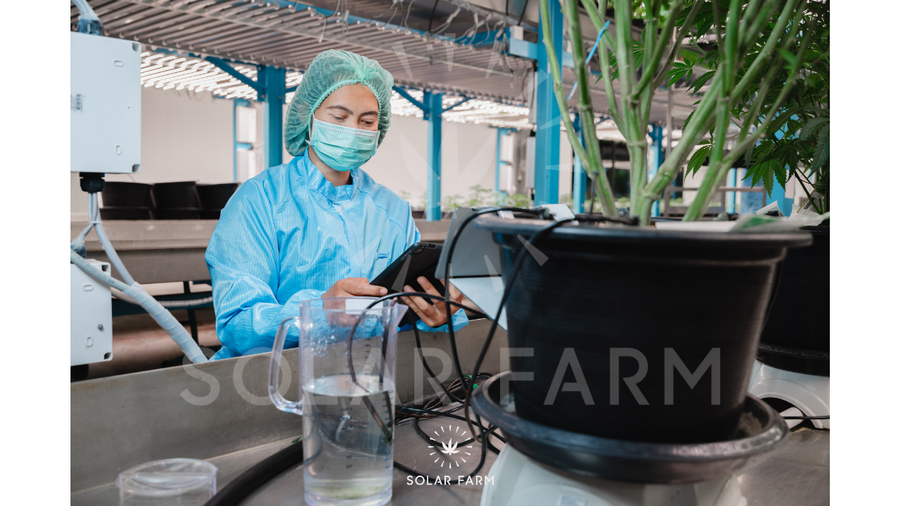
Target ranges
Runoff volume: 10–20% of input is the common benchmark.
pH drift: Runoff pH should stay within ±0.2–0.3 of the feed solution. Larger shifts signal root-zone imbalance.
EC / PPM drift: Acceptable range is typically feed ±100–200 PPM (500 scale). Bigger differences mean either underfeeding or salt buildup.
Step-by-step practice
- Place a clean container under a representative plant
- Apply irrigation as scheduled
- Wait until dripping stops
- Measure feed and runoff volumes to calculate runoff percentage
- Record feed pH and PPM, then runoff pH and PPM
- Enter data with plant ID, date, room, and operator initials
How to use the data
- Low runoff (<5%): Increase irrigation volume or frequency
- High runoff (>25%): Reduce frequency or volume to save nutrients
- High runoff EC / PPM: Indicates salt accumulation; consider flushing or adjusting feed strength
- Low runoff EC / PPM: May point to underfeeding or nutrient lockout
At Solar Farm Thailand, runoff testing is part of daily climate and fertigation checks. Staff collect data from each room, compare against targets, and adjust programs within hours. This ensures stable root-zone conditions and keeps flower output uniform for cannabis wholesale Thailand and cannabis wholesale Bangkok buyers.
Keeping runoff readings comparable
A runoff figure is only useful when the next one is taken the same way. Nominate sample plants in each room at transplant and keep them for the whole cycle, in positions that reflect the room rather than the easiest pot by the door.
Sample from the first irrigation of the day and read pH and EC within a few minutes; a sample left standing in a warm room has changed by the time it is read.
Meters need their own record. Typical practice is to check pH and EC probes against reference solutions on a fixed schedule, logging the date, the reading before adjustment and the operator. Probe drift often masquerades as root-zone drift.
What an auditor or licensed buyer expects to see
Under GACP the runoff log is evidence that the irrigation SOP is being followed. Entries should be dated, legible, signed and complete, with gaps explained; corrections are struck through and initialled, never overwritten.
A reviewer will pick a batch, ask for its room and dates, and expect the matching runoff records quickly. With 22 flowering rooms at Solar Farm Thailand, that depends on room and plant ID appearing on every line. An out-of-range value with no corrective action recorded is a common audit finding.
Licensed buyers rarely ask for the log, but they do ask how batch-to-batch consistency is controlled. A stable runoff trend shown alongside the batch’s third-party Certificate of Analysis answers with data rather than assurance.
Common failure modes and corrective actions
Most anomalies in a runoff log are irrigation faults, not nutrition faults. Rule these out before changing feed strength:
- Blocked emitters: one sample plant gives little runoff while its neighbours are normal. Check emitter flow with a measuring cup before adjusting the schedule.
- Channelling through dry substrate: high runoff volume with runoff EC close to the feed. Rewet in short pulses, then re-measure.
- Flush-day readings mistaken for underfeeding. Mark flush events on the log.
- Runoff EC climbing late in flower as uptake slows. Reduce feed strength stepwise rather than flushing repeatedly.
Log the correction beside the reading that triggered it and re-sample the same plant next irrigation. Typical practice is to treat two consecutive in-range readings as closing the deviation.
Last updated: 22 September 2026