Dry Trimming for GACP Cannabis Farm

Dry trimming keeps the cut surface tight and reduces chlorophyll smear. Buds cure evenly and store better. A consistent finish lifts buyer confidence for cannabis wholesale Bangkok and supports audit outcomes.

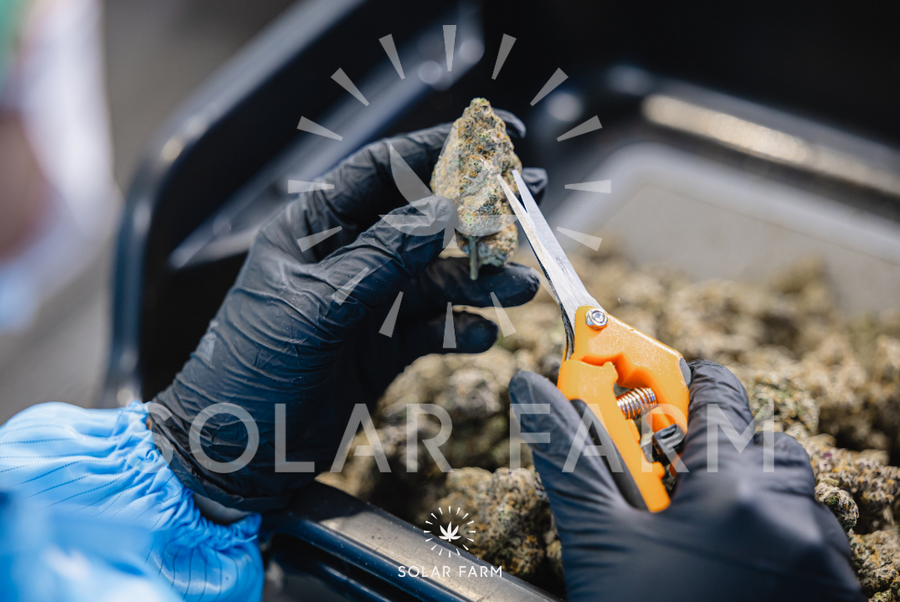

Staff wear lab coats, gloves, face masks, and hair nets. Trays, bins, and scales are cleaned before use. Scissors are sanitized with 99% food-grade alcohol at set intervals. A moisture meter confirms 8–12% before trim to avoid case hardening.
Wash hands, don PPE, and clear the bench. Verify lot ID and moisture range. Remove fan leaves first. Detail around calyx and sugar leaves without gouging flower. Collect trim separately for by-product accounting. Re-sanitize tools on schedule and at any visible soil or resin buildup. Seal finished buds in labeled containers and move to curing or QA hold.
QA checks weight loss, moisture, visual grade, and foreign matter. Nonconforming lots are reworked or quarantined. Records tie each batch to operators and tool lots to satisfy GACP and buyer audits.
Line clearance between cultivars
With 22 flowering rooms, several cultivars usually dry at once, so the bench runs as a single-lot space: one lot is opened, trimmed, sealed and signed off before the next is unpacked. Bins, trays and floor are cleared of the previous lot’s trim, the scale zeroed and the clearance signed before any branch leaves its crate.
Once two cultivars share a bin there is no practical way to separate them, so a mixed bin is downgraded, not guessed at. An auditor looks for the clearance signature and a single lot label on the bench.
Moisture readings a second reader can trust
A reading only counts if it represents the rack, not its driest bud. Readings are taken at several positions, including dense branch centres where drying lags, and logged by position, not averaged. A rack straddling the sheet’s window returns to the drying room with a re-check time noted.
The meter is checked against a reference before each run, in the same log. A meter reading low, or probed only at the surface, passes case-hardened material: dry outside, wet at the core. If water activity climbs in curing, trim sheet and meter log are pulled first; together they show whether the rack came down early or the meter was wrong.
Operator sign-off and the QA hold
Each trimmer’s training record is on file, and a sample of their output is checked against the finish standard during the run. The check looks for over-trimming, where sugar-leaf removal cuts into the calyx and pushes flower weight into the trim bin, and for a loose finish that sheds in transit. Drift is corrected at the bench; the result stays with the lot.
After the final weigh the lot enters QA hold and is sampled for its independent third-party certificate of analysis (COA). The COA reference goes back onto the trim sheet so certificate, bins and room record share one identifier, the thread a licensed buyer pulls when asking Solar Farm Thailand about a certificate. QA then confirms:
- bins, trim sheet and COA sample bag carry one lot label;
- a second person, not the trimmer, has signed the visual grade;
- the meter log and its reference check are attached.
FAQs
What the dry trim record has to show
A trim run is only finished when the paperwork matches the bins. Each lot leaving the trim line at Solar Farm Thailand is logged against the room and cycle it came from, the date the branches came down, the operator who trimmed it and the weights before and after. Trim and popcorn are weighed separately at the bench rather than reconciled later, because a single combined figure hides where the loss happened.
The record matters for two different readers. An auditor wants to see that the lot in front of them traces back to one room and one cycle, with no merged batches along the way. A licensed buyer wants the opposite direction: given a certificate of analysis, they want to reach the room, the harvest date and the people who handled it. Both questions are answered by the same sheet, which is why it is filled in at the bench and not from memory at the end of a shift.
Anything that fails the visual check is bagged, labelled and held rather than quietly dropped back into the run. Held material is reconciled at the end of the lot so the input and output weights close. If they do not close, the lot is not released.
Last updated: 22 September 2026