Tool Hygiene: Scissors Cleaning for Medical Cannabis
Tool hygiene at Solar Farm Thailand is a defined control point. Scissors cleaning prevents cross-contamination, protects yield, and preserves quality for medical cannabis buyers. The practice is embedded in daily work so can keep a stable pipeline for cannabis wholesale in Thailand.

Why scissors cleaning matters
Trimming and plant care rely on precise blades. If resin and sap stay on the metal, pathogens hitch a ride from plant to plant. Edges dull faster, cuts bruise tissue, and infection risk rises. Clean blades cut cleanly, wounds seal faster, and uniform quality holds through the lot. Consistent hygiene supports GACP records and reinforces Solar Farm Thailand’s position as a reliable cannabis wholesaler Thailand serving cannabis wholesale Bangkok.
Cleaning method
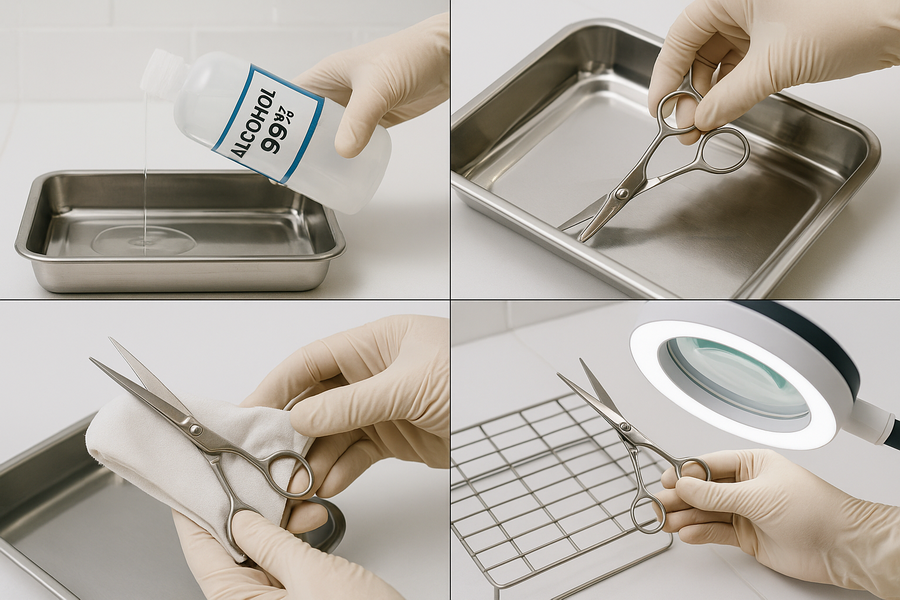
- Prepare a shallow stainless tray with food-grade alcohol
- Scissors are opened to expose the hinge
- The tool sits for 1 minute
- A lint-free cloth wipes blades, joints, and handles
- If any tackiness persists, the cycle repeats until metal surfaces are bright and dry
- Blades air-dry in a protected rack
- Before reuse, the operator performs a visual check under white light
Maintenance and sharpness
Clean metal holds an edge longer. After drying, a thin food-contact lubricant is applied to the pivot if specified in the SOP. Any nicked or misaligned pair is removed from service and tagged. Sharpening and replacement schedules are logged so trimming teams always work with consistent tools.
Traceability and training
Every room keeps a hygiene log. Entries tie scissors IDs to operator names, lots, and timestamps. Supervisors sample tools randomly and swab for residue. Staff receive onboarding and periodic refreshers that cover contact time, wipe technique, and cross-room movement rules. The result is a closed loop that meets GACP and supports repeatable product quality for cannabis wholesale in Thailand.
Rotation, sharpening and the cleaning record
Scissors are handled as a rotating set rather than as personal tools. A trimmer works with one pair while a second pair is in cleaning, which keeps a clean edge in the hand all shift without anyone deciding to push a gummed blade a little further. Sets are counted in and counted out, so a missing pair is noticed on the day rather than at the end of the week.
Sharpness is treated as a hygiene control, not a comfort one. A dull blade crushes rather than cuts, and crushed tissue on the stem is a wetter, more damaged surface than a clean cut leaves behind. That is a contamination risk on the bench and a quality problem in the jar, so blades are checked on a schedule and replaced when honing stops holding an edge.
The cleaning record is deliberately simple: which set, which method, which operator, which shift. Solar Farm Thailand keeps it at the bench so it is filled in as the work happens. Combined with the room and lot records, it means a question about any released batch can be traced to the tools that touched it, which is what a licensed buyer documentation review is actually testing.
Keeping the alcohol bath effective
A tray left open all shift loses strength to evaporation and collects resin from every pair dipped in it, so an auditor wants to see when it was filled and changed, not only that it was used. Typical practice is to replace it on a fixed interval or as soon as it turns cloudy, and to keep it lidded between dips.
Strength matters as much as contact time. General guidance is that alcohol with some water disinfects better than neat alcohol, because water slows evaporation and keeps the metal wet for the full contact period. The usual rule is that product name, batch number and opening date go on the tray, and that a cloth is never reused across pairs, since it carries resin forward.
Tool movement between rooms
Across 22 flowering rooms, the larger risk is not a visibly dirty pair but a clean-looking one carried between rooms. Solar Farm Thailand assigns tool sets to a room, and a set that leaves its room goes through the full cleaning cycle before entering the next.
A room with a recorded pest or suspect plant is handled differently. The usual rule is that tools used on affected plants are bagged, tagged and cleaned last, and stay out of rotation until the room inspection closes the observation.
Findings, deviations and corrective action
A GACP auditor or a licensed buyer’s QA reviewer rarely asks whether tools are cleaned. They ask for the SOP, the hygiene log and the swab results, and compare the three. Common findings:
- a week of entries written up in one sitting, in the same pen;
- a swab result with no follow-up recorded against it;
- a tagged-out pair still racked with working tools.
A failed swab or visual check is written up as a deviation: the pair is cleaned again and re-swabbed, the plants it touched since its last recorded clean are traced through the lot record, and the operator repeats the missed step. Where the same pair or operator keeps appearing, the fix moves from the person to the procedure. That trail, from finding to closure, makes the log evidence beside the third-party COA rather than a tick sheet.
Last updated: 14 September 2026