Seed Germination: GACP Method for Medical Cannabis
Seed germination is the first control point in Solar Farm Thailand’s production system. Strong, uniform seedlings reduce loss, stabilize crop timing, and improve medical cannabis supply for buyers in Thailand.

Why Germination Matters
Germination is the first control point in the crop. When seedlings emerge fast and even, survival rises and loss drops. Schedules stabilize, so veg and flowers stay on time. Plants start with stronger tissues and cleaner roots, which lowers disease pressure. The result is steady upstream volume for medical buyers in Thailand.
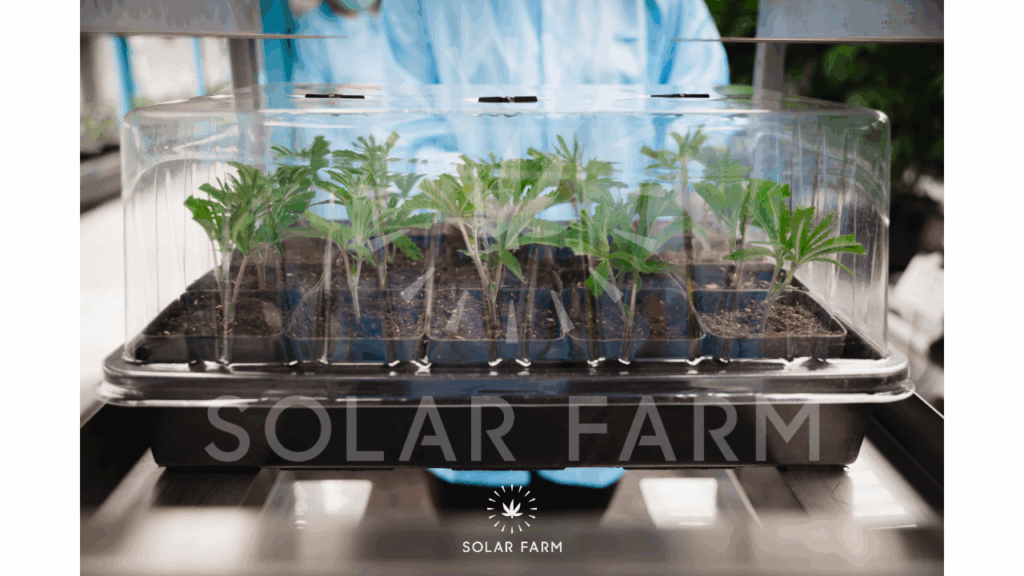
GACP Controls From Day 0
Work begins with hygiene. Staff gown, sanitize tools, and enter through a clean area. Every tray carries strain, lot, and sowing date. Operators follow a short SOP for each shift and record any deviation with the action taken. These habits create repeatable outcomes and clear audits.

Media and Equipment
Use inert plugs or fine coco that has been rinsed to near zero EC and adjusted to pH 5.8 to 6.2. Load sterile trays and fit humidity domes. Prepare misting water at pH 5.8 to 6.0 and 0 to 100 PPM on the 500 scale. Handle seeds with alcohol-sanitized tweezers. Label with printed tags and link each tray to a QR code for traceability.
Moisture Management
Aim for evenly moist media with no pooling. Use water at pH 5.8 to 6.0 and 0 to 100 PPM on the 500 scale. Add a mild Ca-Mg at 2 to 4 ml per liter only when plugs show early deficiency signs. From day three onward allow light surface dry-back between mists to strengthen roots.

Recordkeeping and Traceability
Log sowing date, strain, vendor, lot, and operator. Record germination percentage on days three, five, and seven. Track daily temperature, RH, and PPFD. Note actions taken, cull reasons, and totals. Link batch IDs to the transplant map so any audit can follow the plants through veg and flower.
Common Issues and Fixes
Damping-off signals too much moisture and stale air. Reduce humidity, increase air exchange, and sanitize benches. Helmet head needs a brief rise in humidity and a drop of water to soften the seed coat. Stretching means light is too weak or too far. Increase PPFD to 150 to 200 and lower the fixture within safe limits. Slow emergence often points to low temperature or overwatering. Verify setpoints and correct the schedule.
Seed Lot Acceptance Before Sowing
GACP regards seed as propagation material with a documented source, so the record starts before sowing. Each incoming lot is checked against its paperwork: cultivar, supplier, lot number, quantity and receipt date. Packets are inspected for damage, damp and pest sign, and counts reconciled with the delivery note.
Accepted seed is stored sealed, cool and dry, location logged. A lot whose label and paperwork disagree is quarantined, not sown; a mislabelled cultivar is a traceability failure no downstream test can correct. A viability check per lot gives an expected emergence figure to set against the day three to day seven counts.
Calibration, Setpoints and Deviation Closure
The pH and EC values in the germination SOP are only as reliable as the meters behind them. Typical practice is to check meters against fresh buffer and reference solution each shift and log the result; an out-of-window reading means a re-check before any water reaches a tray.
Temperature, humidity and light sensors are cross-checked against a reference instrument on a fixed schedule. A GACP auditor asks for that schedule and its evidence, then compares controller setpoints with the controlled SOP. Every deviation needs a root cause, corrective action and signed close-out; open deviations and uncontrolled bench copies of an SOP are frequent findings.
Release to Veg and What Licensed Buyers Ask For
A seedling leaves germination only when it meets written release criteria, initialled per tray:
- true leaves open, no twisting or bleaching
- white roots visible at the plug wall
- no lesion or constriction at the media line
- height within the band set for the lot
Anything outside the criteria is culled, counted and destroyed under the site’s waste procedure, reason recorded. The release record reconciles seeds sown, seedlings emerged, culls and plants transplanted; an unaccounted plant is a licensing finding as much as a quality finding.
Buyer QA teams seldom ask about germination itself, but do ask whether a batch traces to its propagation source. The seed lot, sowing record and transplant map behind each independent third-party Certificate of Analysis are that evidence, and the records Solar Farm Thailand’s Thai GACP (MOPH/DTAM) certification is audited against.
Last updated: 1 October 2026