Leaf Trimming and De-leafing for Medical Cannabis Quality
At Solar Farm Thailand in Pathum Thani, north of Bangkok, leaf trimming and de-leafing sit inside defined GACP procedures. The goal is simple. Keep light and air moving through the canopy so flowers develop evenly and dry cleanly. Selective removal at set checkpoints improves light penetration, reduces humid microclimates, and helps the plant spend energy where it matters most. Records of dates, rooms, operators, and actions support traceability for medical cannabis wholesale in Thailand.

Why Leaf Trimming and De-leafing Matter
Leaves power photosynthesis, yet excess or poorly placed foliage shades bud sites and traps moisture. Thinning restores canopy efficiency. Better light use supports a uniform bud set. More airflow lowers the risk of Botrytis during flower and drying. Facilities that maintain active air movement and controlled humidity report fewer mold events.
Vegetative Stage
Young plants often stack large fan leaves that block nodes below. In veg we remove select oversized fan leaves that cast heavy shade, clear the lowest weak growth that will never reach the light, and shape a structure that spreads tops evenly before flip. Work is light and regular rather than heavy and rare. Gradual edits limit stress and preserve vigor.
Early to Mid Flower
Once stretch begins, canopy management becomes decisive. We target fan leaves that sit directly over active bud sites and remove unlit lower branches that will not produce saleable flowers. We keep healthy leaves that still gather light for nearby sites. The aim is a breathable canopy with consistent PPFD at the top and fewer moisture pockets inside. Overly aggressive removal in flowers can slow growth, so passes stay targeted and timed.
Final Clean Before Harvest
Late in flower we remove remaining yellowing, damaged, or shaded leaves. This improves air movement through dense tops, reduces contamination risk at harvest, and presents a cleaner surface for drying and curing. The result is more predictable moisture loss and fewer rejects for appearance or mold.
What We Do Not Do
We do not strip healthy foliage without purpose. Abrupt or extensive defoliation can shock plants and compromise yield. When in doubt we stage the work across smaller passes and observe response before proceeding.
Environmental Link
Trimming and de-leafing work only when paired with room control. Maintain airflow across and through the canopy. Keep relative humidity in the appropriate range for flowering, often 40 to 60 percent, to limit Botrytis pressure. Space plants and use horizontal airflow fans to break up stagnant zones. Log RH changes at lights off when spikes are common.
Tool Hygiene and Waste Handling on Every Pass
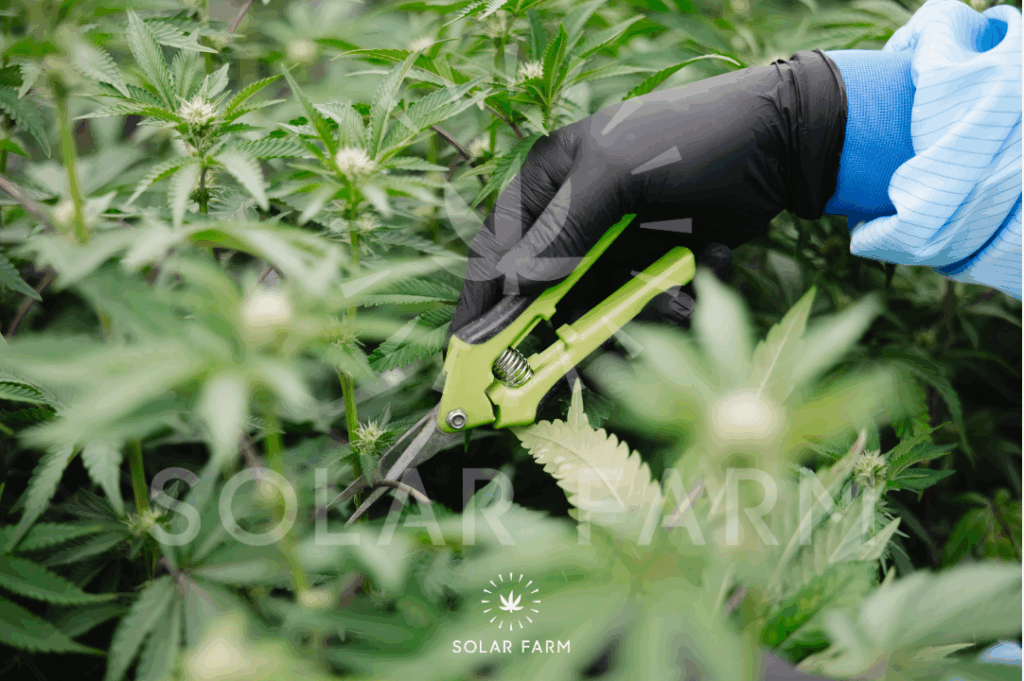
A de-leafing pass at Solar Farm Thailand begins with clean snips, fresh gloves and a sanitiser station at the room door. Blades are wiped between plants and re-sanitised between rooms; a cutting tool is the most direct route for pests or pathogens between canopies.
Clean rooms are worked first, any room under pest or disease watch last. Removed material goes into a labelled bag, never onto the floor or media, and goes out with the operator; litter left overnight in a warm, humid room feeds the Botrytis the pass was meant to prevent. Cuts are made at the petiole, never torn, and passes run after lights-on, when room humidity is typically lowest.
What the Batch Record Captures
Each pass is entered against the lot in the batch record: room, cultivar, stage gate (vegetative, early flower or pre-harvest clean), operator, times and what was removed. A follow-up note records how the plants responded, so a stalled stretch can be traced to the pass before it, and the entry is cross-referenced to that day’s environment log.
A GACP auditor asks for a versioned SOP, training records tied to that version, batch entries that match its stage gates, and a deviation with corrective action wherever a pass exceeded scope. A licensed buyer asks it more simply: can the batch on the certificate of analysis be followed back through every canopy intervention that shaped it?
Common Failure Modes and Their Corrections
Pass problems show in the canopy within days; the next room walk is where they are caught.
- Over-removal in mid flower, seen as stalled bud swell or a thin, pale canopy: halt passes on that lot, log the deviation and allow recovery before the pre-harvest clean.
- A dense and an open cultivar on the same schedule: record canopy density per cultivar and set pass intensity from that note, not the calendar.
- Pre-harvest clean left too late: bring it forward so yellowing leaves are gone before flowers are handled at harvest.
A second signature, typically the room lead’s, closes each correction, and the deviation pattern feeds the next SOP revision, where pass timing per cultivar is tuned. That review separates a documented GACP practice from a habit.
FAQs
Is de-leafing the same as trimming?
Trimming is a general canopy clean up. De-leafing is selective removal of fan leaves that block light or airflow. Both target better distribution of light and air across bud sites.
Does de-leafing stress plants?
Any removal is a stressor. Stress stays low when work is targeted and staged. Avoid large single-session stripping, especially in mid flower.
How often should plants be de-leafed?
At defined gates. Light touch during veg. A targeted pass in early flowers once stretched reveals crowding. A final clean before harvest. Adjust by cultivar density and room conditions.
Last updated: 14 September 2026