Nursery Care for Clones
Solar Farm Thailand runs tight nursery care so clones start uniform; this control layer shortens veg and lifts COA pass rates at our cannabis farm north of Bangkok for cannabis wholesale Thailand.
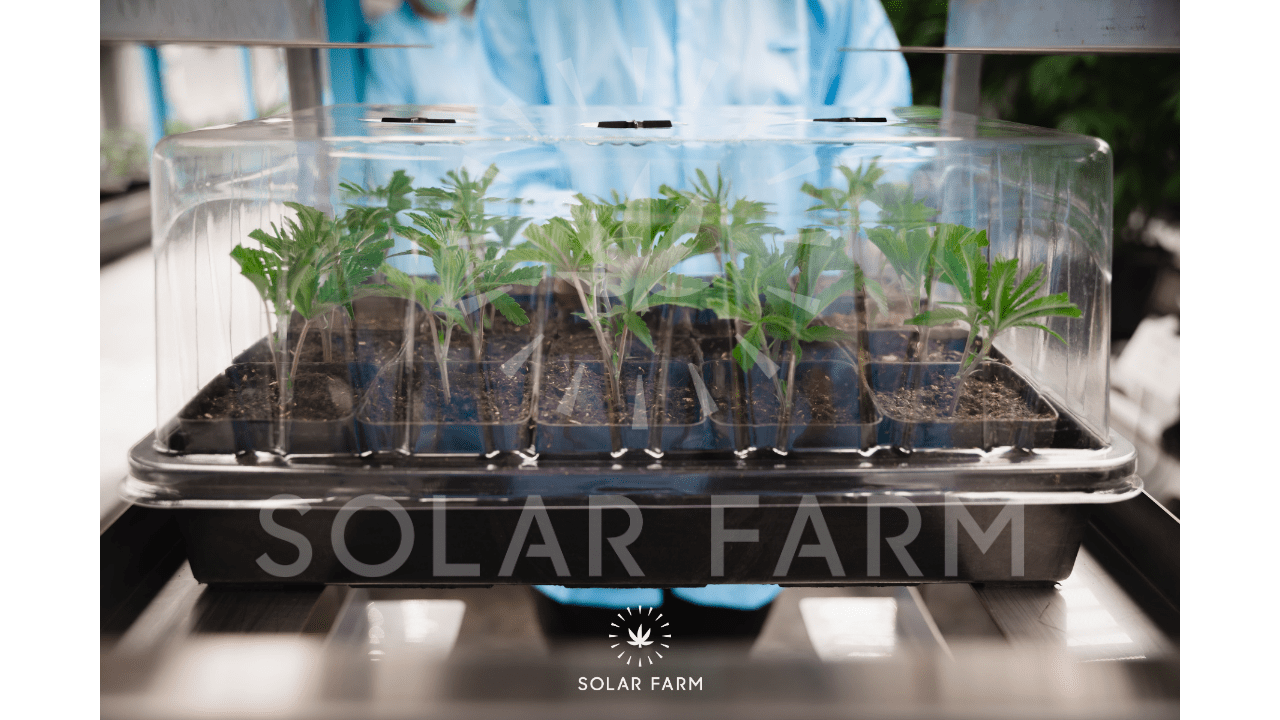
Nursery is where quality starts. GACP expects documented, repeatable practices from the moment you take a cutting, with traceability, hygiene, and staff oversight baked in. Our nursery at Solar Farm Thailand follows that model so every tray can pass an audit and progress cleanly into veg.
Rooting environment for clones
We set the environment for rooting, not speed trials. Cuttings sit at 24–26 °C with high humidity under domes, then harden down to ~70–75% RH as roots establish; CO₂ stays ambient (≈400–600 ppm), lights run 18/6 at low PPFD (100–200 µmol/m²/s), and VPD stays soft at 0.4–0.8 kPa. Domes are vented a little more each day so plants adapt without wilting, then removed once roots are reliable, a gradual off-ramp that reduces shock.
Media, pH and feed in the nursery
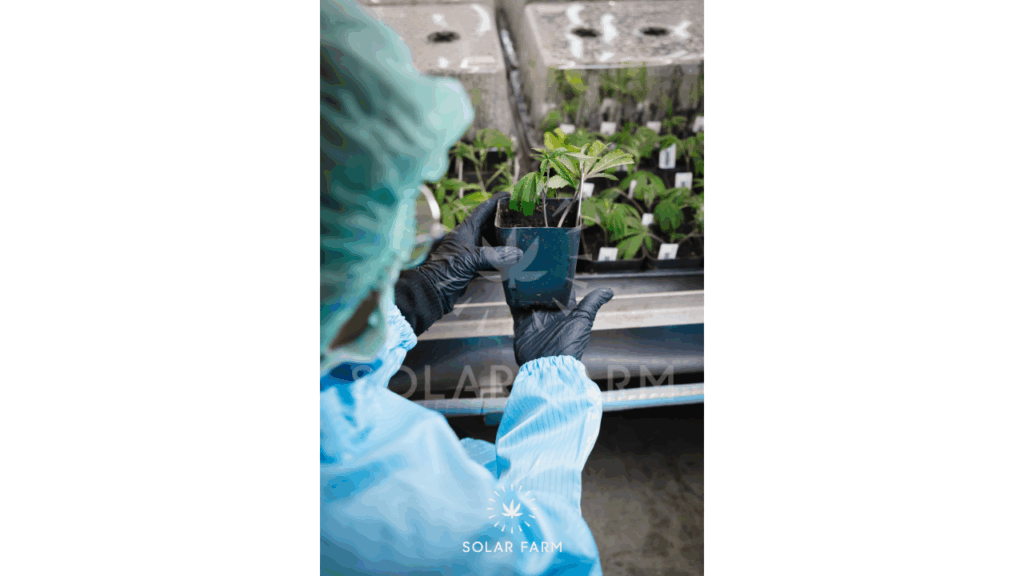
Media prep is standardized. We use washed, aerated coco in 4-inch pots, pre-water to field capacity, buffer with Ca/Mg, and hold substrate pH around 5.8–6.3.
The feed solution sits inside the coco range of ~ 5.5 – 6.5 (500-scale targets are lower in the nursery), which keeps key ions available and prevents early lockout.
Daily nursery routine and checks
Daily work follows a tight loop: set targets, measure, act, and log. Teams check turgor and color each morning, tap pots to confirm white roots at the edge, crack domes in short sessions during hardening, and record tray ID, mother ID, observations, and actions. Clean records and clear responsibilities are part of GACP/GPP expectations and make audits faster.
Progress is gated by age and roots, not hope.
- Day 10: first root check; weak trays stay fully covered.
- Day 12–14: partial vent if ≥30% of plugs show visible roots.
- Day 16–18: harden off if ≥70% show roots on all sides; discard unrooted or weak clones with supervisor approval.
These gates keep the cohort even and reduce downstream stall.

Hygiene and one-way movement
Hygiene is non-negotiable. Tools, domes, and benches are sanitized before use; PPE is required; movement is one-way (mother → clone → veg); and sticky cards are checked weekly. GPP-style hygiene controls, coupled with complete batch and training records, are what external reviewers expect to see.
Quality gates and KPIs
We close the loop with defined quality gates and KPIs. “Harden-ready” means roots on two sides with no chlorosis; “transplant-ready” means roots around the plug with no wilt after two hours dome-free. We track rooting success at Day 14 and Day 18, rescue/discard rates, time to transplant readiness, 72-hour post-transplant stall, and nursery deviations per 1,000 cuts. Those numbers tell us, and buyers, that the process is
KPIs
- Rooting success at day 14 and day 18
- Rescue and discard rates
- Time to transplant readiness
- Post-transplant stall rate at 72 hours
- Nursery deviations per 1,000 cuts
Outcome: Uniform starts reduce disease pressure, keep canopies even, and support medical-grade, audit-ready lots at a GACP cannabis farm north of Bangkok.
Batch records and traceability from mother to veg
Each cohort of cuttings at Solar Farm Thailand carries a batch record that opens at the cut and closes when the tray goes to veg: mother plant, cultivar, cutting count, media lot, date and person responsible, signed at each gate, not afterwards.
Its value is reconciliation: cuttings taken, rooted, rescued, discarded and transplanted must add up, and any gap is a deviation. A GACP auditor picks a finished lot, takes its third-party COA and walks the records back to a mother ID and a nursery date at the Khlong Luang, Pathum Thani site. A licensed buyer’s QA team asks the same question from the other end.
Corrections follow standard practice: a single line through the error, the new entry, initials and a date. Blank fields and overwritten figures are what reviewers notice first.
Verifying the readings behind the setpoints
Setpoints are only as good as the readings. Room sensors report the room air, so handheld probes spot-check inside the domes, where conditions differ; both go into the tray log so drift shows across a cohort.
Typical practice is to calibrate pH and EC meters against reference buffers before each day of use, log the result, and retire a probe that drifts out of calibration rather than keep adjusting it. An auditor asks for the calibration log before the setpoints.
Common nursery failure modes and corrective actions
Most nursery losses trace to a few causes, each with a standard response.
- Stem rot at the plug line: media too wet under stagnant dome air. Vent earlier, reduce pre-watering, isolate the tray and open a deviation.
- Stretch and thin stems: light intensity left too low for too long. Raise it within the nursery range as roots show.
- Uneven rooting across a bench: gradients between edge and centre. Rotate trays at each check and map root scores by position.
- Fungus gnats on the sticky cards: persistently wet media. Lengthen the dry-back and quarantine that media lot until counts fall.
Each corrective action goes into the batch record with a root cause, and the next cohort is checked for recurrence. That closed loop separates a nursery that passes an audit from one that merely looks tidy.
Last updated: 14 September 2026