Why Water and Nutrients Matter
At a GACP cannabis farm, water chemistry and nutrient strength determine quality. Accordingly, Solar Farm Thailand measures runoff and controls supply pH and PPM (500 scale) so each lot meets medical-grade specifications for cannabis wholesale in Thailand.
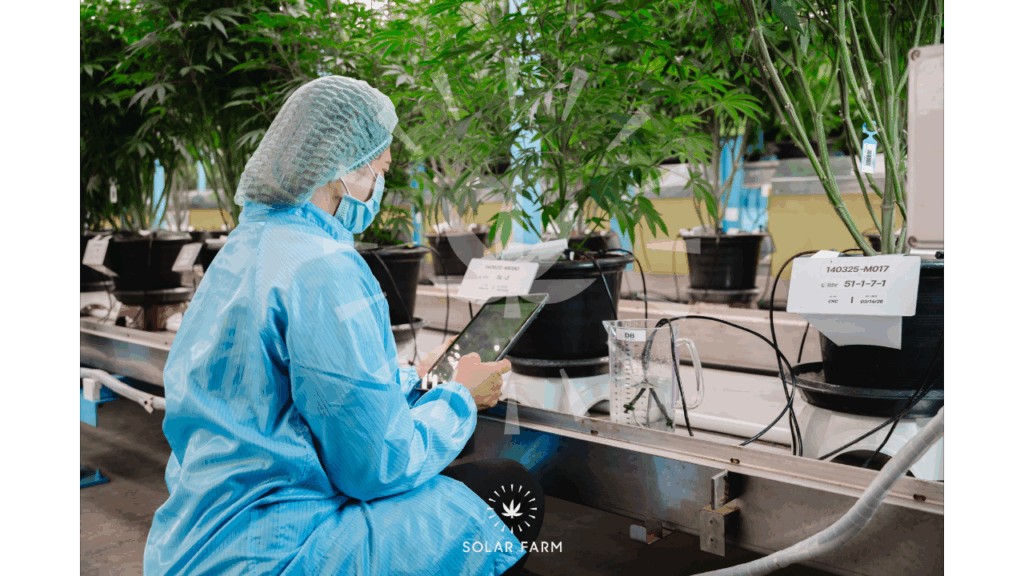
Why Runoff Matters
Runoff reflects what roots actually experience, not just what the tank says. Reading pH and PPM from both feed and runoff shows uptake efficiency, salt accumulation, and media condition. This evidence lets a GACP cultivation team correct problems early and keep every lot within medical specifications for cannabis wholesale in Thailand.
Use a clean measuring jug, labeled catch trays, a pH meter, a PPM 500 scale meter, and alcohol wipes. Calibrate the pH meter daily with pH 7 and pH 4 solutions. Rinse probes with RO water before and after each reading. Stir samples for 10 to 15 seconds before recording values to stabilize readings.
Step-by-Step Protocol
- Select representative plants across the room: front, middle, back, and near doors or AC outlets.
- Record plant ID and pre-feed pot weight if you track weight.
- Feed on schedule. Note feed volume in milliliters and the time applied.
- Wait until dripping stops. Collect runoff in a clean container and measure the volume.
- Test feed pH and PPM, then test runoff pH and PPM.
- Compute runoff percent as (runoff ÷ feed) × 100.
- Log date, room, plant ID, operator, feed pH, feed PPM 500, runoff pH, runoff PPM 500, runoff percent, and notes.
Source water and the reservoir come first
Runoff is only readable if the input is known: source water carries its own pH and background PPM, which shifts what the same recipe reads. Typical practice is to test the supply for heavy metals and microbial load at least annually and after any change of source: both appear on the third-party COA, and irrigation water is one route to the flower.
The reservoir is logged as a batch of its own: mixing order, final pH and PPM after adjustment, and the times the tank was made up and emptied. Concentrates go in one at a time, because calcium added alongside sulphate or phosphate drops out of solution, and a PPM meter cannot show which ions were lost. Solar Farm Thailand tests feed before runoff on every round for the same reason.
What a GACP auditor reads in the runoff log
An auditor spends less time on the numbers than on whether the record stands on its own without the operator: date, room, lot identifier, operator initials and meter used on every line, corrections as a single strike-through, initialled and dated, never overwritten.
Calibration sits alongside it: buffer lot number, expiry and the reading before adjustment, logged each time, because a meter that read high for days offsets every value in that stretch. Licensed buyers ask for the same record in another form: the irrigation log for one batch, tied to its COA.
Habits that distort the runoff log
Most runoff problems trace back to habit, not chemistry:
- Sampling the convenient plants by the door, so the back corner never reaches the log.
- Reading from a tray that was not emptied, so residue from the previous feed inflates the PPM.
- Storing the pH probe dry, which slows its response and pushes it towards drift.
- Changing the tank on a single high reading, before the trend is confirmed.
Each is logged as a deviation with the procedure change and the date it was closed. Where runoff PPM has climbed above the input, the usual response is extra volume at reduced strength, pH adjusted, until it falls back, with recovery shown across consecutive entries. A room that does not respond is escalated; emitters and substrate are inspected before the recipe is touched.
Conclusion
Runoff testing, pH, and PPM measurement form the backbone of GACP cultivation. At Solar Farm Thailand, these checks guide irrigation and nutrition; together they help plants mature into safe, consistent medical cannabis ready for bulk supply.
Reading the runoff numbers day to day
A single runoff reading says very little. The value is in the direction it moves over several days, which is why Solar Farm Thailand records volume, pH and PPM at the same point in the cycle each day rather than whenever someone passes the bench. Two rooms with the same recipe can drift apart quickly, and the log is what makes that visible before the canopy shows it.
Rising runoff PPM with steady input usually means the plant is taking up less than it is being given, and the answer is normally volume and frequency rather than a stronger mix. Falling runoff PPM alongside rising volume points the other way. Drifting pH is read against the substrate rather than the tank, because coco behaves differently at the end of a cycle than at the start.
Dripper checks belong in the same round. A partially blocked emitter produces a plant that looks like a nutrient problem and is in fact a plumbing one, and it will not correct no matter what goes in the tank. Logging the dripper condition next to the runoff numbers is what separates the two, and it is the reason the daily sheet carries both.
Last updated: 14 September 2026